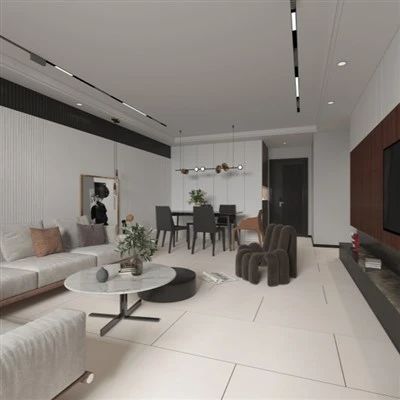
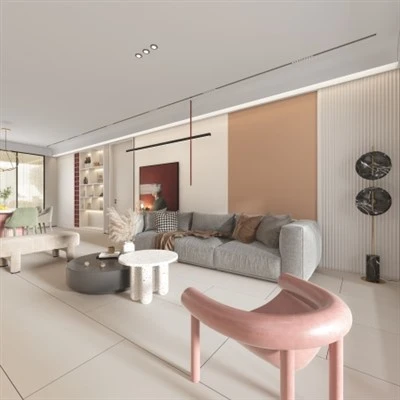
In the world of architectural and decorative materials, there exists a stone that has traversed thousands of years and remains a classic cherished by architects to this day, thanks to its unique porous texture and warm, tactile quality-this is travertine. Scientifically known as "calcareous tuff," this natural stone, with its naturally formed porous structure and rich cultural significance, serves as a unique medium that bridges history and modernity, nature and human culture.
A Natural Work of Art
The formation of travertine tile is a long and wondrous process. When underground water rich in carbon dioxide dissolves calcium carbonate and rises to the surface, the carbon dioxide is released, becoming trapped within the sedimentary layers of calcium carbonate and creating distinctive bubbles and pores. Formed through rapid deposition in rivers, lakes, or hot springs, this rock retains beautiful patterns and unique porous structures because organic matter and gases are not fully released in time. It is this natural sculpting that makes each piece of tile a one-of-a-kind masterpiece.
Travertine primarily comes in beige tones, boasting rich textures and clear veining that evoke a sense of warmth and tranquility. From ultra-white and cream the type of tile to golden and coffee-colored varieties, its diverse color palette offers designers broad creative possibilities. Among these, Italian Roman travertine-with its ivory base, straight grain, and fine pores-is regarded as the finest of its kind and was favored by architectural master I. M. Pei.
An Architectural Legacy Across Millennia
The use of travertine tile dates back to ancient Rome. The Colosseum, the most iconic symbol of Roman culture, stands as a classic example of travertine's application. Built in AD 80, this magnificent structure witnessed the glory of the Roman Empire and demonstrated the exceptional quality of travertine as a building material. From then on, this tile became inseparable from classical architecture.
In modern architecture, this tile continues to exude unique charm. I. M. Pei's design of the Bank of China Headquarters in Beijing utilized 50,000 square meters of Italian Roman travertine for both its interior and exterior, fully capturing the stone's texture and color. The 20,000-square-meter Roman travertine façade of the Jiangsu Art Museum creates a rich rhythmic effect with its alternating light and dark vertical elevations. Landmark buildings such as the Beijing New Poly Plaza and the Shenzhen KK100 have also chosen travertine tile as their primary decorative material, allowing these modern structures to embody contemporary aesthetics while carrying profound historical and cultural depth.
Exceptional Performance and Wide Applications
Travertine's enduring appeal over millennia stems not only from its unique aesthetic value but also from its excellent physical properties. It has uniform lithology, moderate hardness, and is easy to quarry and process. Its light weight facilitates transportation, and it offers good workability, sound insulation, and thermal insulation, allowing for deep processing and diverse applications. These characteristics make travertine an ideal material for architectural decoration.
In application, this tile is remarkably versatile. It can be used for building façades, imparting a dignified and grand presence; for interior walls and flooring, creating warm and comfortable spaces; carved into sculptures and custom forms to showcase designers' creativity; or used as garden stones for bonsai and rockeries, integrating natural beauty into daily life. In recent years, with the rise of interior styles such as "cream tone" and "wabi-sabi," it has become increasingly popular in residential spaces, emerging as the material of choice for those pursuing a quality lifestyle.
Innovation in Modern Craftsmanship
While natural travertine boasts many advantages, it also has limitations, such as relatively low strength, high water absorption, and poor freeze-thaw resistance. To address these drawbacks, the modern stone industry has continuously innovated, developing high-performance artificial travertine products. Dongpeng's travertine, created through the pioneering "pregnant melt" technology fired at 1250°C, far exceeds the strength of natural travertine tile, with a water absorption rate of only 0.5%, while perfectly preserving the stone's natural texture and veining. Such technological innovations have expanded travertine's range of applications and significantly improved its safety.
Timeless Artistic Appeal
The reason tile has spanned millennia and remains beloved by architects and designers lies in the fact that it is more than just a building material-it is a cultural symbol and an artistic medium. Its warm texture, natural patterns, and unique pores seem to tell stories of thousands of years, giving every structure that uses travertine a unique soul.
In a modern society that prioritizes speed, efficiency, and standardization, travertine-with its natural, rustic, and historically rich qualities-reminds us that true beauty requires time to mature, and true classics can transcend time and space. As one designer noted, "Travertine evokes traditional emotions while symbolizing the future-it is classic and never goes out of style." This is perhaps the true reason why it has become the stone of architectural art.
From the ancient Roman Colosseum to modern skyscrapers, from European classical architecture to contemporary Eastern design, it has carved its own legend in architectural history with its unique charm. It is not merely a stone but a culture, an art, and a dialogue spanning millennia. In future architectural designs, this tile will undoubtedly continue to create beautiful spatial experiences for humanity with its warm texture and profound cultural heritage.