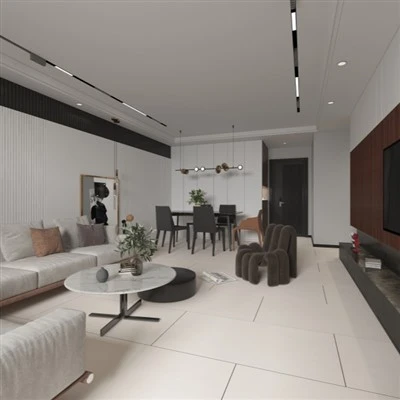
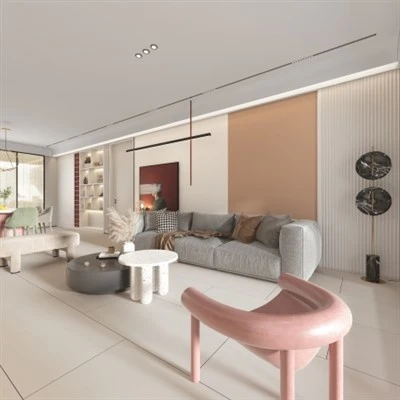
In modern home renovation, glossy floor tiles have become a popular choice for many households due to their unique luster and space-enhancing effects. With their high surface gloss and strong reflectivity, they effectively enhance the sense of spatial transparency and brightness, making them particularly suitable for spaces with lower floors or weaker indoor lighting.
01 Advantages of Glossy Floor Tiles
The most notable advantage of glossy floor tiles lies in their excellent light-reflecting and brightening effects. Their finely polished surfaces effectively enhance spatial brightness. For small living rooms with poor natural lighting, glossy tiles can reflect light, making the space appear more open visually.
In terms of practicality, glossy tiles exhibit high hardness and exceptional wear resistance. The dense internal structure formed during the firing process allows them to withstand daily wear and tear, maintaining a polished and new appearance over time.
Easy cleaning and maintenance are another highlight of glossy tiles. Their smooth, fine glazed surfaces are less prone to accumulating stains, making daily cleaning very convenient. The textures and colors of glossy tiles are relatively more vibrant and diverse, enabling them to create various styles such as light luxury, American, and New Chinese.
02 Potential Issues to Consider
Despite their many advantages, glossy floor tiles also have some drawbacks that cannot be overlooked. The most prominent issue is their relatively poor slip resistance. The smooth surface of glossy tiles significantly reduces friction when wet, posing potential safety risks for elderly family members and children.
In terms of cleaning, glossy tiles may appear pristine and bright, but they actually require frequent maintenance. Due to their high surface smoothness, minor stains and dust are particularly noticeable under the reflection of light.
Optical issues are also worth noting. Glossy tiles are prone to light reflection, which, for households with ambient lighting designs, may result in mottled light spots on the ceiling.
03 Comparison of Glossy, Matte, and Satin Tiles
Gloss level is the core indicator for distinguishing these three types of tiles. Glossy tiles have a gloss level of 90 degrees or higher, matte tiles have a gloss level of 15 degrees or lower, and satin tiles fall somewhere in between.
In terms of slip resistance, matte tiles perform the best, glossy tiles are the weakest, and satin tiles are in between.
From a visual perspective, glossy tiles give a bright and luxurious feeling; matte tiles appear sophisticated and textured; satin tiles offer comfortable light reflection along with slip resistance and durability.
Regarding style adaptability, glossy tiles are suitable for modern minimalist, European, and light luxury styles; matte tiles are better suited for wabi-sabi, rustic wood, and minimalist styles; satin tiles are largely unrestricted by style.
04 Practical Selection Advice
Spatial function is the primary consideration when choosing glossy tiles. Glossy tiles are particularly suitable for public areas such as living rooms and dining rooms, as they effectively reflect light and visually expand the space. However, caution is needed in areas frequently exposed to water, such as kitchens and bathrooms.
Family composition is equally important. Households with elderly members or children should carefully consider the use of glossy tiles in private spaces such as bedrooms.
To address lighting issues, pairing glossy tiles with light-colored, warm-toned, and minimally patterned designs can help avoid a cold feel. Using warm-toned lighting and soft furnishings can also effectively "warm up" the space.
When it comes to specifications, reasonable decisions should be made based on the size of the house. For small homes under 100 square meters, full-floor coverage with 800x800mm tiles offers high cost-effectiveness. For larger homes over 100 square meters, 750x1500mm tiles are more suitable, as fewer seams create a more spacious and elegant look.
Consumers who choose glossy tiles are often attracted by their ability to enhance spatial brightness and visually expand the space. Especially for small homes or residences with poor lighting, glossy tiles can instantly brighten the space, creating an open and sophisticated living atmosphere.
However, there is no perfect renovation material in the world. The shortcomings of glossy tiles in slip resistance need to be compensated for by users through measures such as anti-slip mats or selecting glossy tiles with anti-slip treatments. While cleaning and maintenance are relatively convenient, they require more frequent attention.
Ultimately, the decision should be based on specific needs: glossy tiles are an ideal choice for small homes with poor lighting, modern minimalist styles, and households without elderly members or young children. Otherwise, matte or satin tiles can be considered as alternatives.